Arc-process evidence
CO2/MIG Voltage-Current Setting and Spatter Diagnosis
Use this page when a MIG/CO2 welder has unstable arc, spatter, stubbing, burn-back or a mismatch between voltage and wire-feed current.
Voltage and current must be diagnosed together
In CO2 short-circuit transfer, panel current is mainly wire-feed speed. Voltage controls arc length and melting behavior. A narrow voltage mismatch can turn a stable arc into harsh popping, burn-back, wire stubbing or spatter.
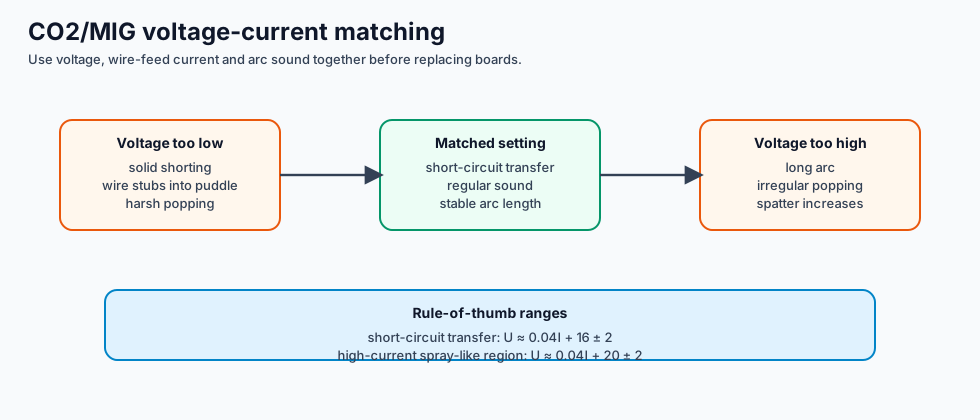
Setting symptoms
| Observed behavior | Likely direction | Evidence to check |
|---|---|---|
| Wire stubs into puddle / harsh shorting | Voltage too low or wire feed too high | Raise voltage slightly, check wire speed, contact tip and liner drag. |
| Long arc, irregular popping, heavy spatter | Voltage too high for wire-feed current | Reduce voltage, verify stickout and gas flow. |
| Arc unstable after cable extension | Voltage drop / feedback issue | Check return cable, voltage feedback lead and output cable length. |
| Porosity with unstable arc | Gas shielding and surface condition | Gas purity, nozzle blockage, flow rate, rust/oil/water and wind. |
Rules of thumb
For short-circuit transfer below roughly 200 A, use U ≈ 0.04I + 16 ± 2 as a starting zone. For higher-current spray-like regions, use U ≈ 0.04I + 20 ± 2 as a separate starting zone. These are diagnostic anchors, not final procedure settings.