Circuit
TIG HF Start Control: 40V Arc-Voltage Detection and 4-Second Cutoff Logic
A WelderData circuit reference for TIG high-frequency start timing, arc-voltage threshold behavior and HF relay release diagnosis.
This page has a specific TIG HF role
This page should remain a timing and cutoff-control subtopic, not a duplicate of the full HF discharge-path page.
Related TIG HF start pages
TIG HF content is separated by user intent: broad fault entry, diagnostic route, general sequence, timing/cutoff subtopic, discharge-path circuit and component testing.
Database summary
This WelderData circuit record explains a TIG high-frequency start pattern that uses output-voltage evidence to decide when HF ignition should be present and when it must stop. The useful service point is the separation between high-frequency generation, arc-voltage detection and timed cutoff behavior.
In this control pattern, HF is allowed while the machine is trying to start an arc. Once the arc is established, arc voltage falls below the start threshold and HF should be removed. If the high-voltage no-load condition remains present for roughly four seconds, the control path cuts HF rather than allowing continuous high-frequency output.
WelderData circuit map
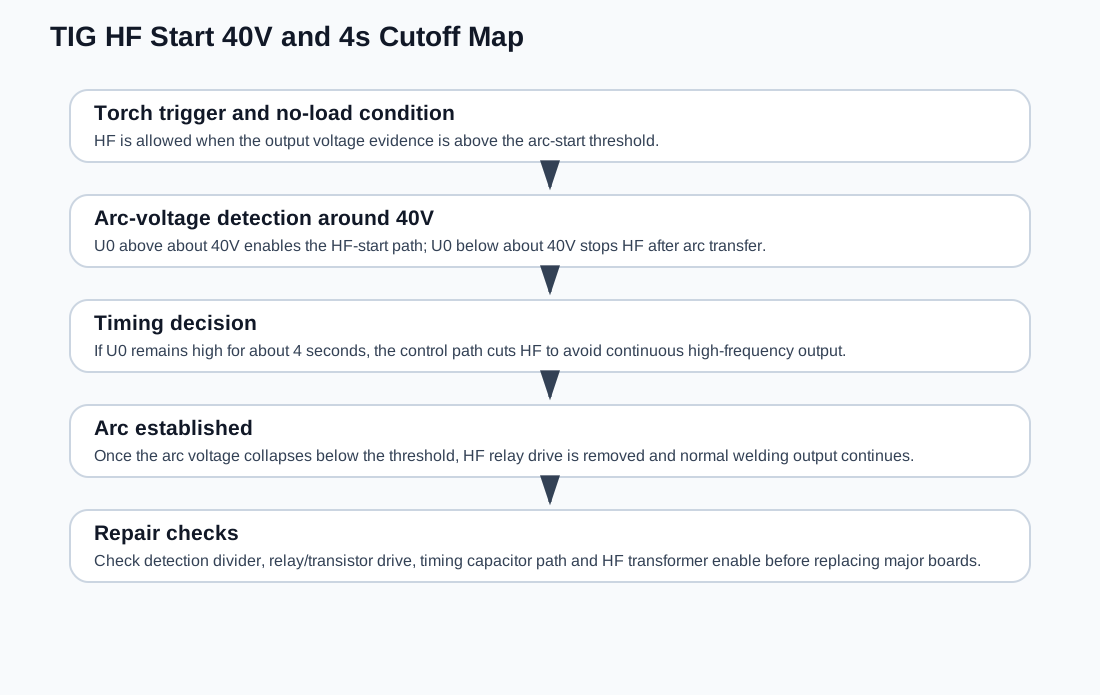
40V arc-voltage decision
The TIG start circuit uses output-voltage evidence as a state signal. When the output voltage is above about 40V, the welder is still in an arc-start condition and HF ignition is allowed. When the arc is established, the welding arc pulls the voltage below the threshold, so the HF relay or HF enable path should release.
For repair work, this means a machine with no HF start should not be diagnosed only at the spark gap or HF transformer. The service sequence should also include the arc-voltage sensing path, divider components, comparator/output stage and the relay or transistor that enables the HF circuit.
Four-second cutoff behavior
If the output voltage remains above the start threshold for about four seconds, the control logic removes the HF-start command. This protects the machine from keeping the high-frequency circuit active when the arc has not transferred. A technician may see HF appear briefly and then stop even though the torch switch is still held.
That behavior can be normal if the arc did not establish. It becomes a fault when the timing path cuts off too early, never resets, or keeps HF running after arc transfer. In those cases, check the timing capacitor/resistor path, relay drive, feedback transistor and the voltage-detection signal before changing the HF transformer.
Fault routing
| Symptom | Likely section | Next check |
|---|---|---|
| No HF at all | Torch command, HF relay drive or HF transformer enable | Confirm torch switch input, gas/output enable and relay transistor path. |
| HF appears then stops after a few seconds | Timed cutoff path or failed arc transfer | Check whether arc voltage dropped below the threshold during the attempt. |
| HF continues after arc starts | Arc-voltage detection or cutoff release failure | Check the feedback divider and relay-release control stage. |
| HF spark exists but arc does not transfer | Torch, work clamp, output voltage or gas path | Do not treat the HF oscillator alone as proof that TIG output is healthy. |
Related WelderData pages
Related repair map
Follow the evidence path from symptom to measurement, circuit and repair case.