Circuit
TIG Low-Current Touch Start Control: Short-Circuit Detection, Hot-Start Current and Arc Recognition
A WelderData circuit reference for low-current TIG contact start and lift-start style arc initiation where high-frequency ignition is not used or must be avoided.
Database summary
Low-current TIG contact start is used when continuous high-frequency start may interfere with nearby control electronics or when a machine is designed to start without an HF oscillator. The control problem is not only “touch and lift.” The power source must recognize a short-circuit contact, limit the initial current, detect when the electrode has lifted, apply a brief hot-start current, then transfer to the selected welding current.
WelderData treats this as a start-sequence circuit: torch command, short-circuit recognition, arc-voltage recognition, current transition and repeat-start/fault logic must be separated before replacing the main power stage.
WelderData sequence map
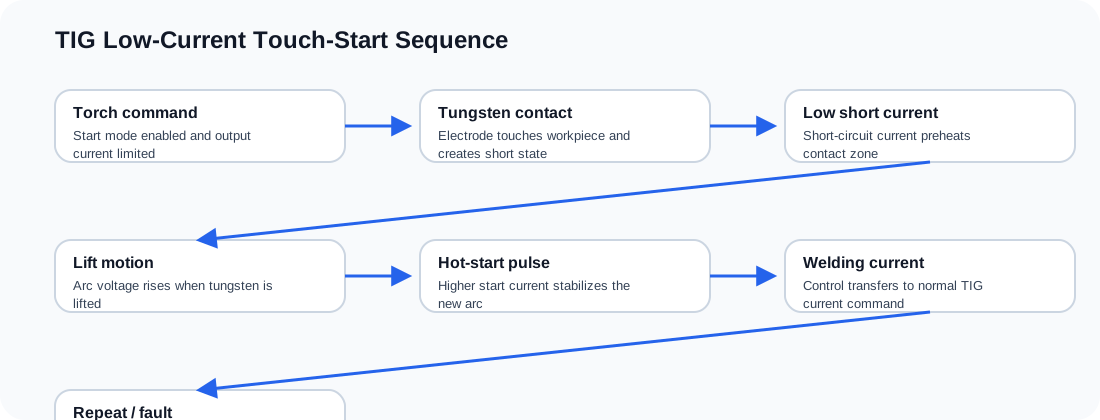
Four-stage start sequence
| Stage | Control evidence | Repair meaning |
|---|---|---|
| Contact / short state | Electrode touches workpiece; arc voltage is near the short-recognition range. | The machine should not deliver full welding current immediately. |
| Low short-circuit current | A limited current heats the contact point without destroying the tungsten. | If the tungsten sticks hard, check current limit and recognition timing. |
| Lift and arc recognition | Voltage rises after the torch is lifted; the control board recognizes arc formation. | If arc never establishes, check voltage sensing, lift timing and work return. |
| Hot start to welding current | A brief hot-start current stabilizes the arc before normal welding current takes over. | If the arc starts then goes out, check hot-start current, hot-start duration and current-loop transition. |
Practical recognition thresholds
One useful service pattern records a very small initial short-circuit current, a short hot-start interval and arc-voltage recognition rather than a continuous HF source. Values such as a low short-circuit current near 5A, a hot-start current around 80A for tens of milliseconds, a welding-current transfer around 50A, and voltage recognition bands for short state and arc-established state should be treated as machine-specific references rather than universal settings.
The repair value is the logic: do not judge touch start by looking only for an HF spark. The correct evidence is whether the machine detects electrode contact, limits current during contact, recognizes lift-off, applies the hot-start stage and then follows the welding-current command.
Common failure interpretations
| Symptom | Likely section | Next check |
|---|---|---|
| Tungsten sticks to workpiece | Short-current limit, recognition delay or lift timing | Verify the low-current start stage before increasing welding current. |
| Arc does not start after lift | Arc-voltage recognition or hot-start stage | Check voltage sensing path and hot-start command. |
| Arc starts then immediately goes out | Current transition or feedback loop | Separate hot-start current from normal welding-current command. |
| Repeated start attempts fail | Repeat-start logic, torch motion or work return path | Check torch switch, clamp, contact condition and start-cycle reset. |