Circuit
ZX7-250 Control Power Rails: ±25V, 7815, 7805 and 7915
A circuit reference for the ZX7-250 low-voltage supply chain, showing how raw ±25V rails and 7815/7805/7915 regulators support control, feedback and driver diagnosis.
Why the control rails come before PWM diagnosis
The ZX7-250 control board cannot be diagnosed from PWM symptoms until its power rails are confirmed. In this repair path, the low-voltage supply is described as approximately +25V and -25V raw rails feeding a regulator chain. The positive side passes through 7815 and then 7805 for the 15V and 5V supplies, while the negative analog rail is generated through 7915. These rails supply the control ICs, analog feedback and driver-support sections.
A missing or unstable rail can imitate many different faults: no PWM, locked protection, false current feedback, no current adjustment, weak drive or repeated IGBT failure. Therefore, the rail page is not only a power-supply page. It is the starting point for separating a dead control board from a power-stage short.
Technical regulator-chain diagram
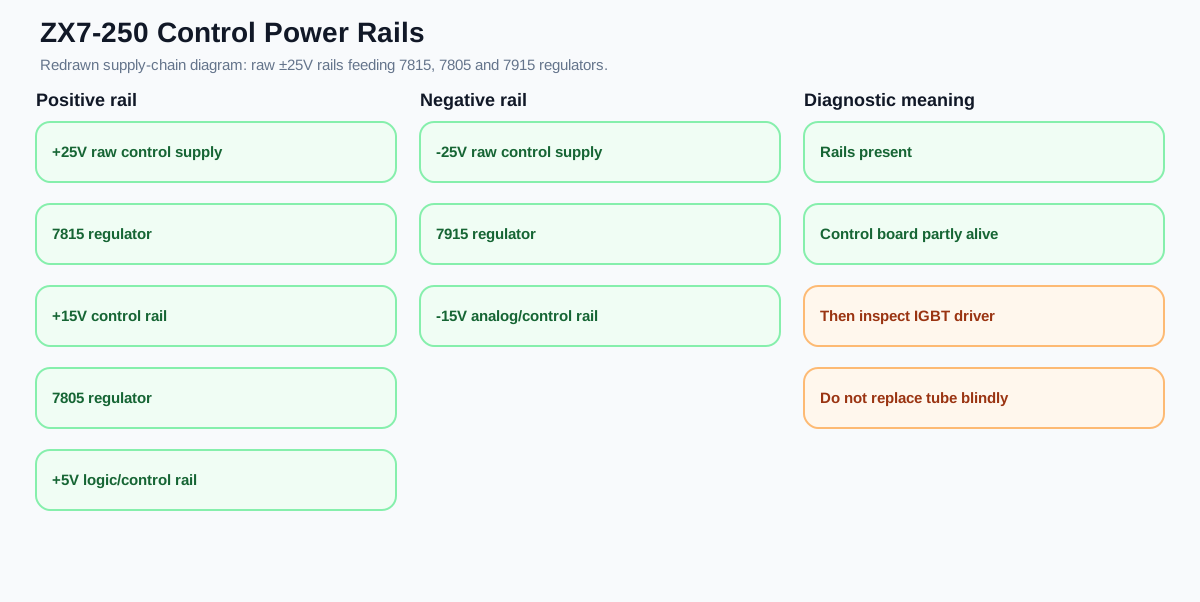
| Measurement point | Expected role | Diagnostic meaning if absent |
|---|---|---|
| Raw +25V area | Input to the positive regulator chain | Check auxiliary transformer, rectifier, filter capacitor or connector. |
| 7815 output | Generates +15V support supply | Downstream analog and driver circuits may not operate correctly. |
| 7805 output | Generates +5V logic/control supply | Control ICs, display logic or protection logic may be dead or unstable. |
| Raw -25V area | Input to the negative regulator path | Negative analog rail cannot be generated if this feed is missing. |
| 7915 output | Generates -15V analog/support supply | Current feedback and amplifier reference behavior may be wrong. |
How to measure without creating new damage
Before measuring any low-voltage rail, discharge the main capacitors and confirm that the machine is in a safe state. If the power stage is known to be shorted, isolate that section first. Rail testing should be done with current limiting where appropriate, and the meter reference point must match the board ground used by the control circuit. A wrong reference can make a good regulator look bad.
Measure the raw rails first. If the raw rails are missing, do not condemn 7815, 7805 or 7915 immediately. The upstream supply, rectifier diodes, connector, transformer winding or filter capacitor may be the actual issue. If the raw rail is present but the regulator output is low, hot or unstable, then check for a shorted downstream load before replacing the regulator.
Rail-fault symptom map
| Symptom | Possible rail-related cause | Next check |
|---|---|---|
| No display or no control response | Missing +5V after 7805 | Check raw +25V, 7815 output, 7805 input/output and downstream short. |
| No PWM but control board partly alive | Missing +15V, -15V or shutdown condition caused by rail fault | Confirm 7815 and 7915 outputs before checking PWM IC pins. |
| Current knob response abnormal | Analog supply or feedback reference shifted | Check -15V rail, feedback amplifier supply and potentiometer reference. |
| Driver signal weak or one-sided | Driver support rail or connector problem | Measure supply at the driver board, not only at the regulator. |
| New IGBTs fail quickly | Driver rail collapses under load or waveform asymmetry | Check rails dynamically and inspect driver components before power-device installation. |
Relation to the H7B short-circuit case
After the H7B short is isolated, the machine showing indicator response and current adjustment change is a positive sign, but it is not the end of diagnosis. The rail chain still needs confirmation. A power device may have failed because the gate drive lost one rail, because the driver section operated asymmetrically, or because the control board was unstable during switching. The +25V / -25V, +15V, +5V and -15V checks are the bridge between “the short is found” and “it is safe to install parts”.
- Confirm raw rails before regulator outputs.
- Confirm regulator outputs before PWM IC diagnosis.
- Confirm driver-board supply before gate waveform diagnosis.
- Treat rail instability as a possible root cause of repeated tube failure.