Repair Case
ZX7-250 H7B IGBT Short Circuit Lamp-Limiter Repair Case
A WelderData board-level repair case showing how a bright 220V series lamp, a shorted H7B power tube, driver-branch checks and staged power-up lead to a safer ZX7-250 fault path.
Case summary and safe starting point
This ZX7-250 repair case starts with a strong symptom: the machine is powered through a 220V series lamp limiter and the lamp remains bright. In WelderData terminology, this is a hard input-current fault pattern, not a normal capacitor-charging event. The safe next step is to stop full-power testing and divide the welder into high-voltage bus, output rectifier, auxiliary supply and driver-control sections.
The machine also has a visible power-device failure. The internal layout includes four main power devices and a symmetrical output-rectifier section. A failed H7B-style device can be the visible result of a deeper gate-drive branch problem, so the repair case does not end when the shorted tube is found.
Technical H7B / DC bus isolation flow
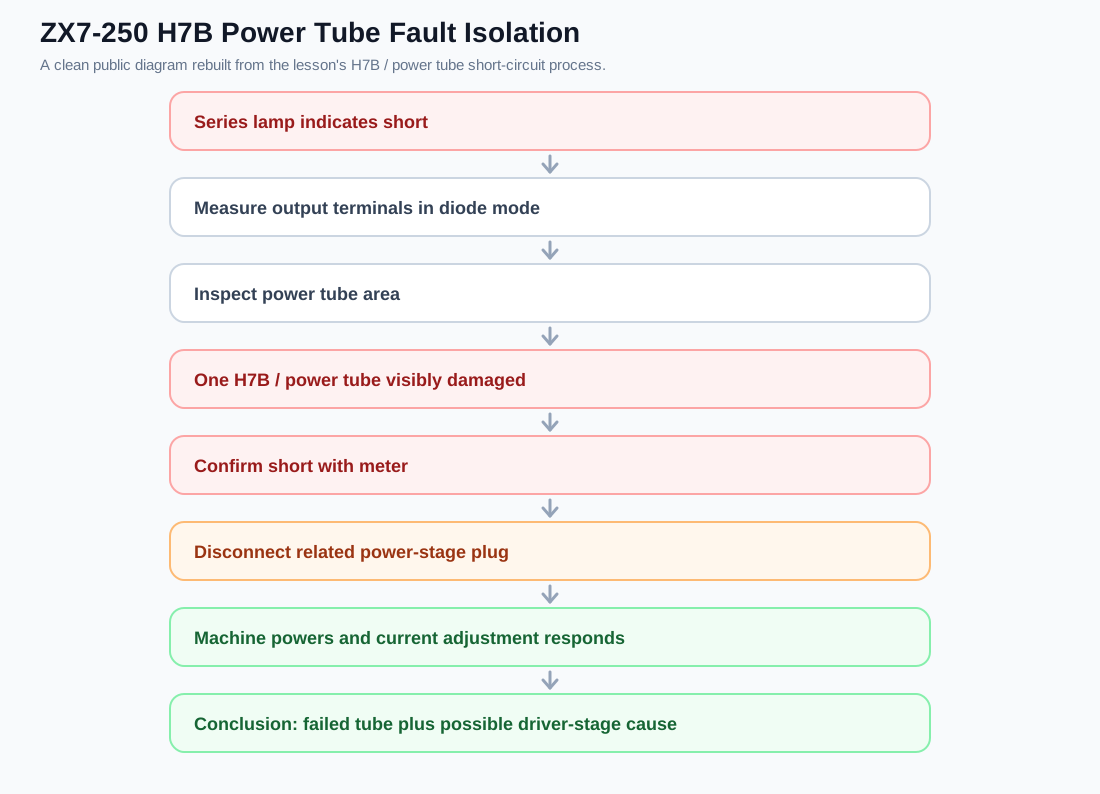
The H7B device is measured as shorted. That short effectively places the high-voltage DC bus under fault. After the suspect power-stage path is disconnected, indicator and current-adjustment response return. This does not prove a complete repair, but it shows that at least part of the control side is alive and that the primary fault concentration is around the power tube and its drive path.
Observed repair record
| Observation | WelderData interpretation | Next action |
|---|---|---|
| Series lamp on 220V input stays bright | Abnormal current draw or hard short remains in the machine | Do not bypass the limiter; isolate the power stage. |
| Output terminals show a diode-mode path around several volts in one direction | Output rectifier paths may show combined junction drops; this is not the same as proving a direct output short | Compare both directions and inspect the power devices and rectifier devices. |
| H7B / power tube measures shorted | The power device has shorted across the bus path | Remove or isolate it and inspect the matching branch. |
| Control response returns after isolating the suspect path | Low-voltage control is not completely dead | Confirm rails and continue into the driver branch. |
| Driver branch contains damaged small parts | The replacement device would be at risk if those parts remain bad | Repair the branch before installing new power tubes. |
Follow-up: driver-output branch after the H7B short
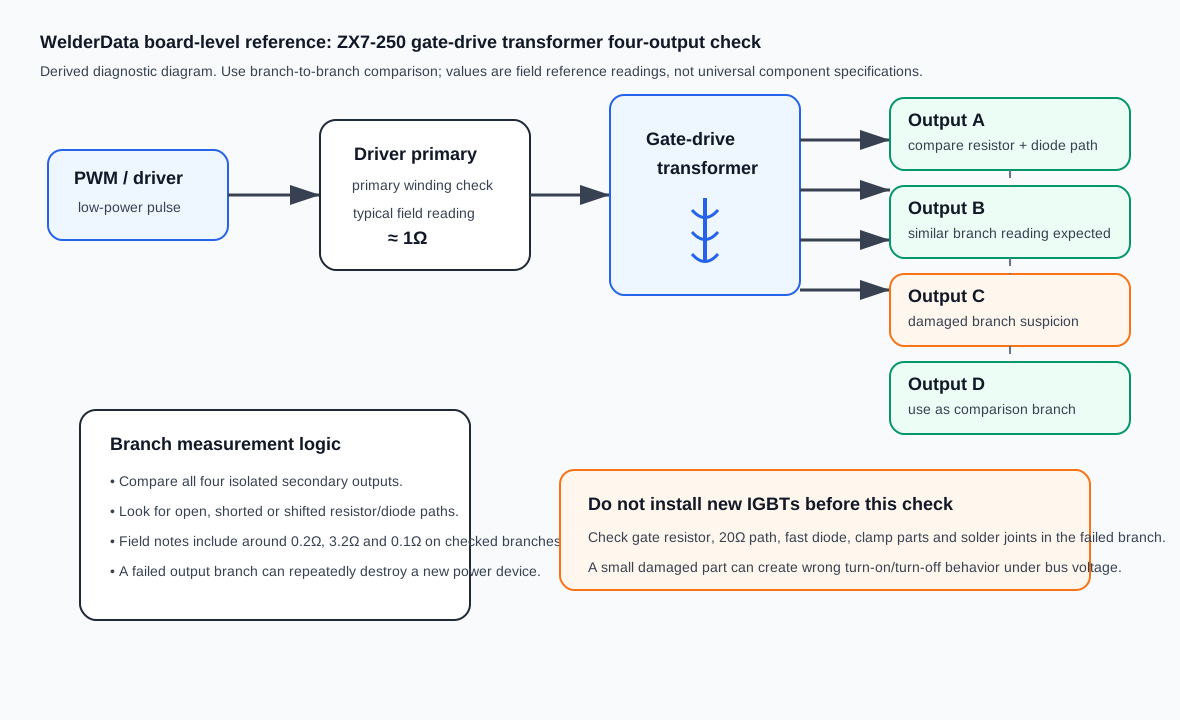
The follow-up database record checks the driver transformer and its four output branches. The primary winding can measure around one ohm in this board family. Four secondary output branches are then compared. Several branches may show low in-circuit readings, but the important clue is whether the branch connected to the blown tube differs from the others or contains damaged parts.
In this repair pattern, the branch associated with the failed device includes damaged small parts such as a 5.1Ω resistor, a 20Ω resistor and a high-speed diode. These parts are not accessories; they define the turn-on, turn-off and clamping behavior of the replacement device. Installing a new H7B, IGBT or MOSFET before repairing this branch can reproduce the same failure.
Final repair logic
- Use the lamp limiter as a diagnostic safety tool, not as a normal operating condition.
- Remove the shorted device and check the matching branch before installing replacements.
- Confirm +25V, -25V, +15V, +5V and -15V rails before waveform diagnosis.
- Check the driver transformer primary and all four secondary output branches.
- Compare 5.1Ω and 20Ω resistors, high-speed diodes and clamp/damping parts across branches.
- Repair damaged small parts, clean carbonized board areas and verify solder joints.
- Restart only with current limiting and staged bus voltage testing.
Why this case is useful in the database
This repair record connects three levels of evidence: the lamp-limiter symptom, the shorted power device and the driver-output branch that can damage replacement parts. It is valuable because it prevents a common repair mistake: replacing the large tube while leaving the damaged gate-drive branch in place. For WelderData, this case is a model entry for repeated power-device failure diagnosis.
Final reassembly and staged power-up validation
The repair record does not stop at replacing the damaged branch parts and power devices. After the missing small resistors and damaged drive-side parts are corrected, the machine is reassembled in stages. The output board, signal board and display panel are returned to position, the power devices are mounted with fresh thermal compound, and connectors are checked before the first energized test.
For the first low-risk start, the 500V-class DC bus path is kept disconnected where the board layout allows. This makes the first power-up a control-side confirmation rather than a full stress test of the inverter bridge. A normal panel display and basic control response are useful, but they do not prove that the main output stage is ready for welding.
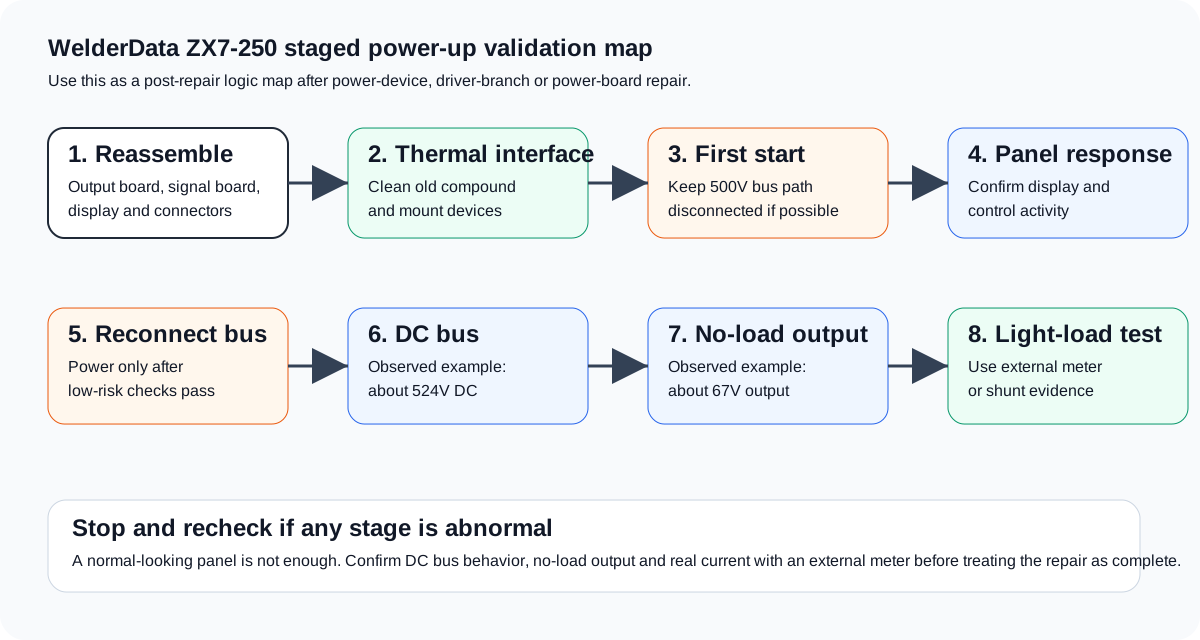
After the low-risk start is acceptable, the DC bus is reconnected and measured. This case records a high-voltage bus reading around 524V DC, followed by an open-circuit output voltage around 67V. The final test is not only a panel-current observation; an external 300A-class meter or shunt is used during a light welding test. The repair pattern records about 50A of real current during this controlled test.
This closing sequence is important because it separates four different kinds of evidence: the control board can wake up, the DC bus can charge, the inverter can produce no-load output, and the machine can deliver real welding current. A repair that passes only the first one or two stages should not be treated as complete.
Case measurement record
This repair case is strongest when each observation is recorded as a measurement. The table below is the preferred WelderData structure for this ZX7-250 H7B short pattern.
| Observation | Meaning in this case | Repair decision |
|---|---|---|
| 220V series lamp remains bright | The machine behaves like a hard input-current short, not a normal charge event | Stop full-mains testing and isolate the DC bus / power stage |
| H7B / power device shorted | The high-voltage bus is being pulled down by the failed switching branch | Remove the failed device and do not install a new one until driver evidence is checked |
| Output rectifier diode-mode reading remains plausible | The secondary output path may not be the primary short source | Continue with driver branch and bus checks rather than replacing random output parts |
| Four gate-drive branches compared | Symmetry separates one damaged gate branch from a common upstream fault | Repair branch-level resistors, fast diodes and clamp parts before restart |
| Panel / current control responds during low-risk checks | The low-voltage control side has some activity, but output is not yet proven | Proceed only to staged validation, not full-load welding |
| DC bus, no-load output and external current checked | The repaired machine is producing real output evidence | Close the case only after controlled light-load validation |
What not to conclude too early
- Do not conclude “the IGBT was the only fault” just because a failed H7B device is visible.
- Do not treat a dim lamp as proof of a safe machine if the driver branch has not been compared.
- Do not use the panel current number as final evidence of welding current without an external meter or shunt check.
- Do not reinstall devices until the mounting surface, thermal compound and heatsink pressure are controlled.
Related WelderData records
Complete workflow / Repair workflows
This repair case is one entry inside a larger WelderData workflow. Use the workflow pages when the machine still needs DC bus routing, gate-drive branch comparison, current feedback verification or staged post-repair validation.