Circuit
ZX7-250 Current Feedback, CT Protection and Shunt Measurement Reference
A WelderData board-level reference for separating simulated current display, CT protection feedback and real output current measured through a rated external shunt.
Database summary
This WelderData circuit record separates three signals that are often confused during ZX7-250 repair: the control-board current display, the current-transformer protection feedback and the real welding current measured through an external shunt. A changing panel display proves that the signal board and current potentiometer path can respond, but it does not prove that welding current is flowing through the output terminals.
The repair value of this page is practical: before adjusting display values, replacing control ICs or judging the power stage, confirm whether the measurement is a simulated board-side value or a true output-current reading taken through a rated current shunt.
WelderData current-feedback map
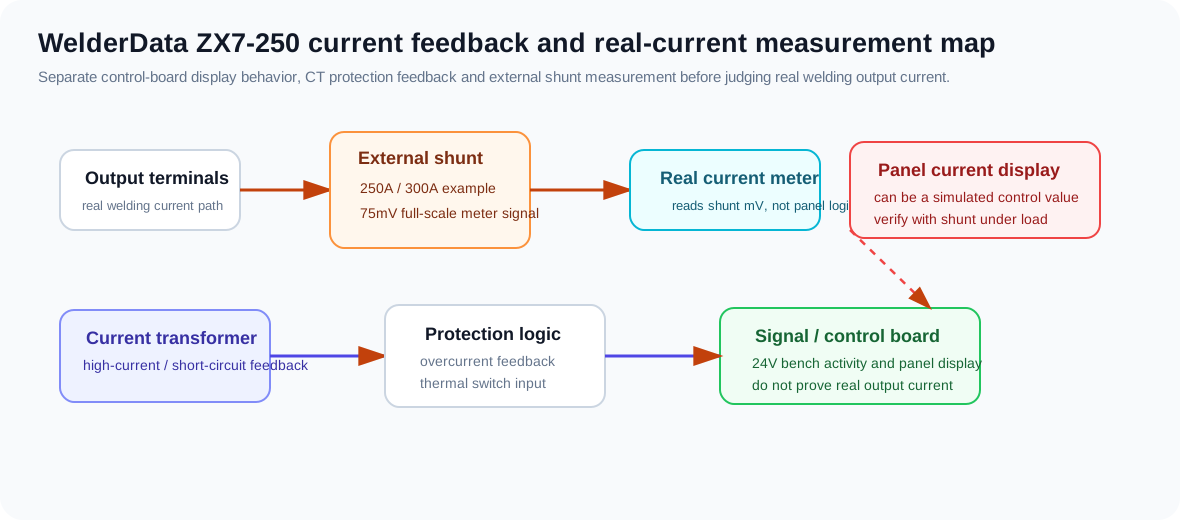
Signal-board 24V bench behavior
A ZX7-250 signal board may be powered from an external 24V supply while the rear power stage is still disconnected or under investigation. This is useful when the rear power section has shorted devices and the technician does not want to energize the complete welder at full power.
If the panel display lights and the displayed current changes when the current potentiometer is moved, treat that result as a control-board response. It is a good sign for the signal-board logic, display path and adjustment path, but it is not a welding-current test. A board can display 150A, 250A or another value without actual current flowing in the output cables.
Current transformer protection role
The current transformer in this repair pattern is mainly a protection-feedback element. It senses large current events and sends a feedback signal into the control/protection circuit. In a short-circuit or severe overcurrent condition, that feedback path can help force shutdown or protection behavior.
This CT feedback should not be confused with an external calibrated shunt measurement. The CT path helps the control circuit react to current stress. The shunt path is used to verify the actual output current delivered through the welding output path.
Thermal and overcurrent protection
For this ZX7-250 board family, WelderData treats overcurrent feedback and thermal switching as the primary protection checks in this section. A thermal switch around the 85°C class is used as a temperature protection input on some boards. If the thermal input is active, the welder can remain blocked even when the display and low-voltage supply appear normal.
Do not diagnose PWM failure or replace the main control device before confirming whether the protection input is being held active by overcurrent feedback, a thermal switch, wiring, connector state or a damaged small-signal protection stage.
Real output current with a 75mV shunt
Real output current should be measured in the output current path using a rated shunt. Common service examples include 250A and 300A shunts. A typical 300A shunt produces 75mV at full-scale current, so a meter with a 75mV input movement can be scaled to read 300A when connected across the shunt sense terminals.
The key check is proportionality. If a 300A / 75mV shunt develops 37.5mV, the output current is approximately 150A. If the panel display says 250A but the shunt voltage shows a much lower real current, the problem may be display calibration, current-feedback scaling, control limitation, output load condition or power-stage weakness.
Service calculation reference
| Shunt rating | Full-scale shunt voltage | Measured shunt voltage | Approximate real current |
|---|---|---|---|
| 300A | 75mV | 75mV | 300A |
| 300A | 75mV | 37.5mV | 150A |
| 250A | 75mV | 30mV | 100A |
| Any matched shunt | rated mV | measured mV | measured mV ÷ rated mV × rated current |
Repair interpretation table
| Observation | What it proves | What it does not prove | Next check |
|---|---|---|---|
| Panel current changes when the knob is turned under 24V bench power | Signal-board display and adjustment path are responding | Real welding current exists | Use a shunt under a safe output test condition |
| CT feedback path enters protection during high current | Protection feedback is active | Panel display calibration is correct | Check CT wiring, protection IC input and thermal input |
| 300A / 75mV shunt shows much less than expected | Actual output current is lower than display or setting | Control board alone is faulty | Check load, output rectifiers, choke, power stage and feedback scaling |
| Thermal input active | Control board may intentionally block operation | Power stage is necessarily shorted | Check thermal switch, connector and temperature path |