MIG / MAG arc-process diagnostics
CO2 MIG Welding Voltage and Current Waveform Diagnosis
Diagnose CO2 / MIG arc problems by comparing voltage waveform, real welding current, output reactor behavior and feedback-loop response.
Database summary
Use this page when a CO2 / MIG welder powers up and feeds wire but the real arc is unstable, harsh, weak or full of spatter. The point is to compare process evidence with control evidence instead of treating every bad arc as a feeder board fault.
The useful repair chain is: wire feed and gas → arc voltage → real welding current → output reactor → voltage/current feedback → PWM or power-stage response.
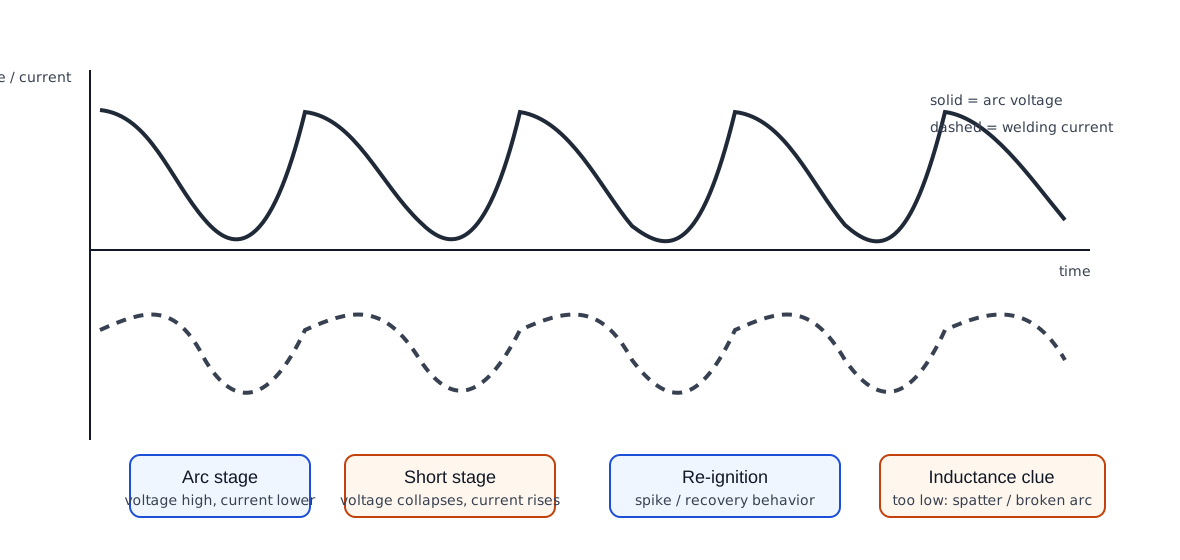
Symptoms routed by waveform evidence
| Observed symptom | Evidence to collect | Likely repair direction |
|---|---|---|
| Large spatter with stable wire feed | Short-circuit current rise and re-ignition recovery | Output reactor, voltage feedback, current loop or drive response |
| Panel current changes but weld force barely changes | Set-current command versus real shunt/current data | Feedback scaling, PWM permission, shunt/CT path or output path |
| Wire stubs into workpiece or burns back | Voltage feedback, burn-back timing and transfer waveform | Feeder interface, torch trigger timing, output enable or voltage sampling |
| OCV normal but welding current is weak | Loaded current, output rectifier heat/drop and reactor continuity | Output rectifier, reactor, shunt, cable path or current feedback |
Diagnostic sequence
- Confirm wire feed, gas flow, torch trigger and work return before reading the power board.
- Measure open-circuit voltage, but do not treat OCV as proof of welding output.
- Collect arc-voltage evidence during a controlled test condition.
- Collect real current evidence from a shunt, CT, Hall sensor or external current meter.
- Compare panel setting, command voltage, PWM response and actual arc current.
- Inspect output rectifier modules, output reactor, shunt connections and return cable joints.
- After board repair, re-check the transfer behavior instead of only checking display and wire feed.
Diagnostic path
| Symptom | Unstable CO2 / MIG arc, excessive spatter, weak loaded current or burn-back/stubbing. |
|---|---|
| Evidence | Arc voltage, real current, transfer waveform, output reactor condition and feedback response. |
| Circuit section | Output rectifier, output reactor, current feedback, voltage feedback and control loop. |
| Next pages | Output reactor and arc-current stability · MIG/MAG process-control routing · Current display vs shunt check |