Circuit
Special TIG Transistor Current-Feedback Power Supply: Hall Sampling, D/A Command and Closed-Loop Arc Current Control
A WelderData circuit reference for special TIG power supplies where current command, Hall sampling and a power transistor group form the welding-current control loop.
Database summary
This circuit family differs from ordinary inverter TIG and SCR TIG machines. A control computer or digital controller sets welding-current parameters, a D/A or filtered analog command creates the reference, Hall current and voltage sensors provide isolated feedback, and a high-power transistor group regulates the arc current.
The useful repair concept is separation: command generation, sampling, feedback amplification, transistor drive, relay sequencing and HF start coordination must be checked as distinct sections.
WelderData control map
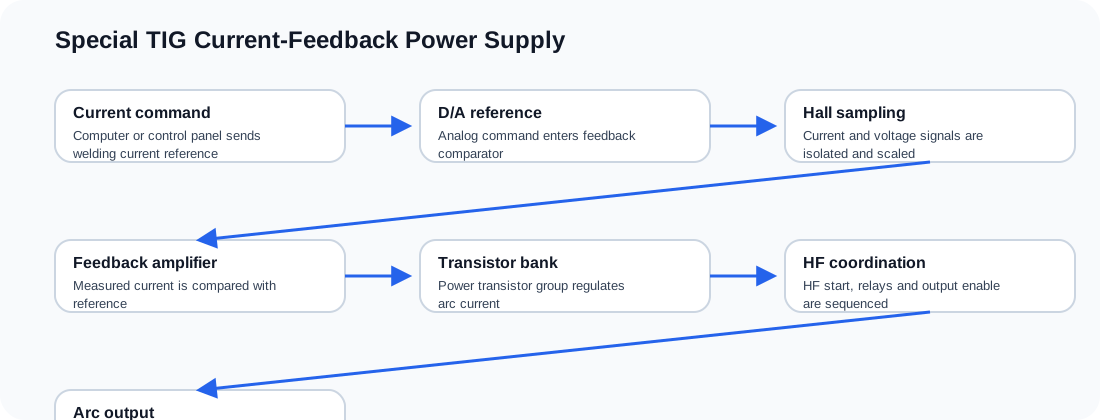
Closed-loop current path
| Section | Role | Repair question |
|---|---|---|
| Current command | Sets the target welding current from computer or panel logic. | Does the reference change when the operator changes parameters? |
| D/A or analog reference | Converts the command into a control voltage. | Is the reference stable and within expected range? |
| Hall current sampling | Isolates and scales real output current feedback. | Does the feedback match external current evidence? |
| Feedback amplifier | Compares current reference and measured current. | Is the error signal driving the transistor stage correctly? |
| Power transistor bank | Regulates arc current rather than switching as a basic inverter stage. | Are devices biased, cooled and protected before load testing? |
| HF / relay coordination | Coordinates arc start, output enable and current regulation. | Does HF start occur without locking the current loop in a wrong state? |
Repair interpretation
If the panel command changes but arc current does not respond, do not replace the transistor group first. Check whether the command reaches the analog reference, whether the Hall sensor feedback is plausible, whether the feedback amplifier output changes, and whether the relay/output-enable path allows current regulation.
If real output current differs from displayed or commanded current, verify with external current evidence. A Hall sensor or scaling stage fault can make the control loop believe the arc current is correct while the actual output is low, high or unstable.