Diagnostic workflow
CO2 Semi-Automatic Welder Maintenance and Fault Examples
A WelderData workflow for routing CO2 / MIG welder maintenance and fault evidence before deeper feeder-board or power-source repair.
Database summary
This WelderData workflow is for semi-automatic CO2 / MIG welders where the complaint may begin as no wire feed, no gas, weak arc, unstable arc, excessive spatter or abnormal stop. The repair value is not in welding technique notes, but in separating the torch command, feeder mechanism, gas circuit, output source and maintenance condition before replacing a board.
Use this page with the MIG / MAG control pages and the six-wire feeder fault table. It is meant for maintenance and first routing, not as a replacement for a specific factory service manual.
WelderData workflow map
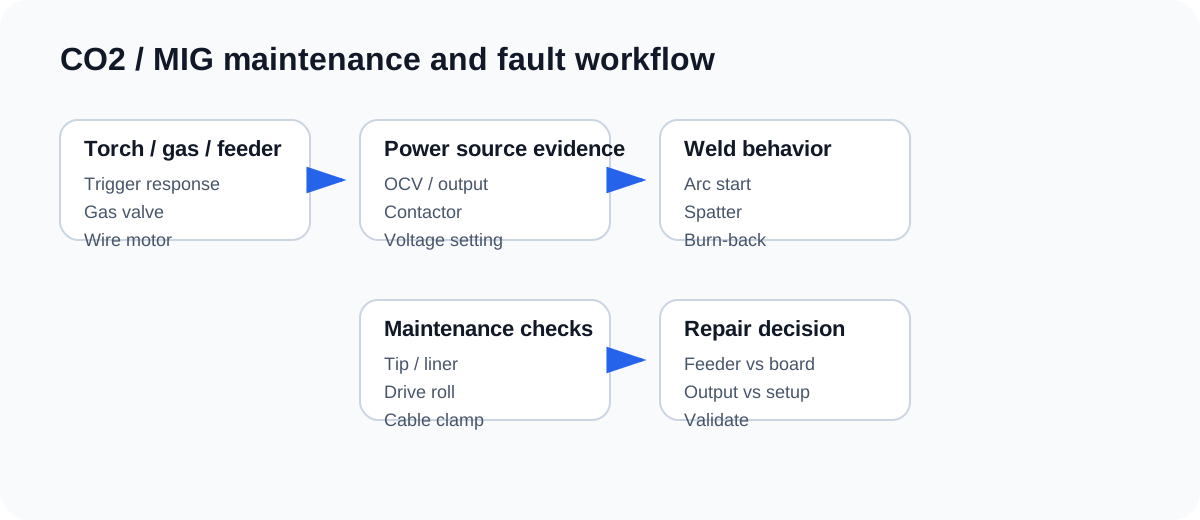
Maintenance checks before board repair
| Area | Why it matters | Repair interpretation |
|---|---|---|
| Contact tip, liner and drive roll | Wire-feed complaints can be caused by mechanical drag, poor contact or wrong feed-roll pressure. | If jog and motor voltage are normal but feed is unstable, inspect the feed path before replacing the feeder board. |
| Work clamp and output cable | No-arc and unstable-arc complaints may be output-loop problems rather than voltage-control faults. | Record output terminal evidence and work-return condition before suspecting the main power source. |
| Gas solenoid and hose path | Pores, bad shielding and no-gas complaints often begin in gas delivery, not the welding output stage. | Separate torch command, solenoid actuation and real gas flow. |
| Torch switch and control plug | A broken torch command can look like no gas, no feed and no output at the same time. | Check trigger continuity and connector pins before changing boards. |
Fault-routing table
| Observed symptom | First routing area | Next page |
|---|---|---|
| No feed and no gas when torch is pressed | Torch switch, control supply, interlock or feeder interface | MIG / MAG common fault routing |
| Gas flows but motor does not run | Feeder motor supply, motor drive, connector or cable harness | 6-wire feeder fault table |
| Wire feeds but arc does not establish | Output cable, work return, OCV evidence, voltage-control path | Wire-feed / voltage control |
| Excessive spatter or unstable bead | Wire speed / voltage match, gas condition, contact tip, output regulation | MIG / MAG routing |
| Burn-back or sticking at stop | Crater-fill, burn-back timing, feeder stop sequence and output decay | Stop timing section |
Service record template
Record the machine family, torch-switch response, gas response, jog response, motor voltage evidence, no-load output evidence, arc behavior, cable condition, maintenance findings and final validation. This keeps a CO2 welder repair from becoming a random sequence of feeder-motor and board replacements.