Plasma diagnostic workflow
KLG-60 Air Plasma Cutter Common Fault Routing
Route KLG-60 air plasma cutter symptoms through contactor, air pressure, high-frequency ignition, torch condition and cutting output before replacing boards.
Database summary
This WelderData diagnostic table is for KLG-60 style air plasma cutters where the symptom may come from the input contactor, compressed-air pressure, 3A control fuse, high-frequency oscillator, torch consumables or main cutting output. It is not a cut-quality tutorial; it is a repair routing page for separating power-source evidence from air-path and torch evidence.
Fault routing map
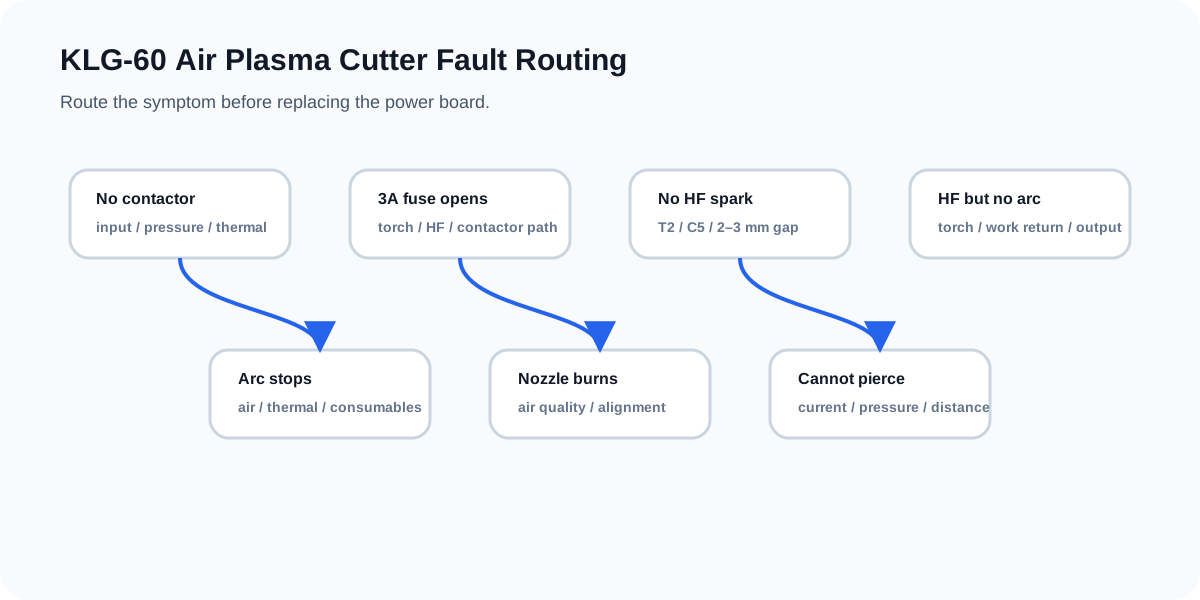
KLG-60 common fault table
| Observed symptom | Likely group | First checks | Repair interpretation |
|---|---|---|---|
| Main contactor does not pull in | Input, control switch, pressure or thermal permission | Check three-phase input, control fuse, pressure switch around the 0.2 MPa action point, thermal relay and contactor coil path. | Do not start with the rectifier bridge until the control-permission chain has been proven. |
| Air and control circuit appear normal, but cutting blows the 3A fuse | Control / HF / torch path short | Inspect torch switch wiring, HF circuit insulation, contactor contacts, output lead routing and burned insulation around the torch cable. | A 3A fuse event is evidence of a control-side or ignition-side fault, not only a main transformer fault. |
| Fan runs, indicator is on and contactors act, but there is no HF spark | HF oscillator | Check HF transformer T2, high-voltage capacitor C5, spark-gap condition, carbon tracking and KM2-1 contact condition. Use the local design gap reference around 2–3 mm only as a field reference. | If HF is missing, route toward the ignition circuit before diagnosing transferred-arc output. |
| HF spark exists but no arc forms between torch and workpiece | Torch, work return, output path | Check nozzle/electrode assembly, work clamp, output cable continuity, torch-to-work distance and DC output evidence. | Do not replace HF parts when HF is already present; the problem may be arc transfer or output current. |
| Arc starts but cannot pierce the workpiece; plasma arc flickers | Air pressure, consumables, main current | Check regulator setting, air-water separator, nozzle/electrode wear, torch assembly, cutting current setting and output connections. | Weak cutting is often mixed: air and consumable faults can hide a marginal power-source fault. |
| Arc extinguishes automatically during cutting | Thermal, pressure drop, consumables or output instability | Watch air pressure under flow, thermal state, output cable heating, electrode/nozzle condition and contactor dropout. | Separate a protective stop from an unstable arc before changing the control board. |
| Nozzle burns quickly | Air quality, assembly, pilot arc path | Check electrode/nozzle alignment, shield cap tightness, air dryness, pressure, slag contamination and wrong nozzle size. | Nozzle burn is not automatically a power-board fault; the torch is part of the plasma circuit. |
| Electrode burns quickly | Air moisture, excessive pilot time, wrong consumables | Check air-water separator, electrode material/fit, cutting distance, pilot duration and return clamp. | Rapid electrode loss often points to air quality or arc-transfer failure. |
| No air flow or very small air flow | Gas path / solenoid / pressure switch | Check compressed-air source, regulator, solenoid valve, hose restriction, torch passage and pressure switch output. | Resolve air delivery before interpreting electrical cutting failure. |
| Kerf is slanted, wide or uneven | Torch geometry and motion plus output evidence | Check nozzle wear, electrode centering, torch angle, air pressure, travel speed and ground return. | Cut shape faults should be routed through torch and setup evidence before board-level repair. |
| Cannot reach rated cutting thickness | Power output, air, consumables, technique | Check actual output current, input voltage, air pressure under flow, nozzle/electrode condition and work return. | This symptom requires evidence from both the power source and the torch/air system. |
Pressure and HF reference notes
| Reference item | Field value from this platform | How to use it |
|---|---|---|
| Pressure switch action | Around 0.2 MPa class | If pressure is below the action point, the control path can be blocked even when the power section is healthy. |
| Panel cutting pressure | About 0.2–0.25 MPa class for KLG-60 material | Use as a platform note, not as a universal plasma pressure setting. |
| HF spark gap | About 2–3 mm class | Check gap, carbon tracking and insulation. Do not widen the gap blindly to force a spark. |
| 3A control fuse | Control / ignition protection clue | If it opens during cutting/start, inspect torch control wiring and HF/contact path before replacing main devices. |