Repair workflow
LGK Plasma Cutter Common Fault Table: Air, HF, Pilot Arc and Cutting Output Checks
A common fault routing page for LGK-style air plasma cutters before moving to model-specific boards or torch parts.
Database summary
This WelderData page routes LGK-style air plasma cutter symptoms through the torch switch, air path, high-frequency ignition, pilot arc, consumables and main cutting output. It is intended as a common fault table for LGK-40, LGK-63 and LGK-100 class cutters and should be used with the exact machine schematic when available.
LGK parameter reference
| Model class | No-load voltage | Rated current | Working voltage | Cut thickness reference | Air pressure reference |
|---|---|---|---|---|---|
| LGK-40 | 250V | 40A | 100V | 12mm | 0.4MPa |
| LGK-63 | 260V | 63A | 110V | 18mm | 0.5MPa |
| LGK-100 | 280V | 100A | 120V | 30mm | 0.6MPa |
These values are routing references. Actual machine ratings, torch type and consumable set must be checked before service decisions.
Air / HF / arc routing map
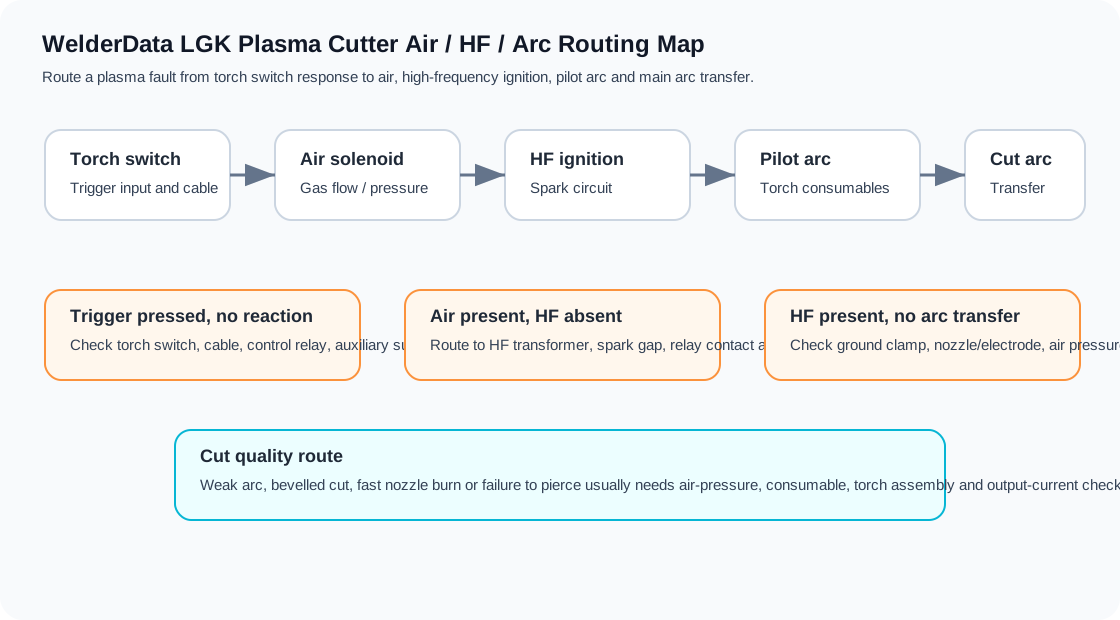
Common LGK plasma cutter fault table
| Observed symptom | Likely groups | WelderData routing |
|---|---|---|
| Power on has no reaction, power indicator off | Input power, switch, fuse, auxiliary supply, wiring | Start with input and low-voltage control supply before torch or HF diagnosis. |
| Press torch switch, no reaction | Torch switch, torch cable, control relay, protection circuit | Check the trigger circuit and protection state first. |
| Press switch, air flows and HF is present but no cutting arc | Ground clamp, workpiece return, nozzle/electrode, pilot arc path, output stage | Do not replace HF parts if HF is already present. Route toward pilot/main arc transfer and output current. |
| Machine makes internal sound but no arc and no air | Solenoid valve, air pressure, control relay, auxiliary supply | Separate air-path failure from power-output failure. |
| Weak cutting arc or cannot pierce rated thickness | Air pressure, consumables, torch assembly, output current, ground cable | Confirm air pressure and consumable condition before power-board replacement. |
| Nozzle or electrode burns quickly | Moist air, incorrect pressure, wrong nozzle/electrode, poor torch assembly, pilot arc abnormal | Inspect consumables and air quality before diagnosing the inverter section. |
KLG-60-style additions: contactor, 3A fuse, HF spark and torch evidence
KLG-60 training material adds a useful practical layer to the broader LGK fault table. In KLG-60 style machines, no-cut symptoms should be separated into contactor permission, 3A control-fuse behavior, high-frequency spark generation, air-pressure permission and torch consumable evidence.
| KLG-60 symptom | First routing direction | Do not conclude too early |
|---|---|---|
| Main contactor does not pull in | Input, control fuse, pressure switch, thermal path and contactor coil. | Do not replace the rectifier bridge before control permission is proven. |
| 3A fuse opens during start/cut | Control wiring, torch switch path, HF insulation and contactor contact path. | Do not oversize the fuse to keep testing. |
| No HF spark | T2, C5, spark gap around 2–3 mm class, carbon tracking and KM2-1 contact. | Do not diagnose transferred-arc output until HF evidence is present. |
| HF spark exists but no arc transfers | Torch consumables, work clamp, output cable and main current evidence. | Do not replace HF parts when HF already exists. |
| Cut cannot pierce or nozzle burns quickly | Air pressure under flow, air quality, electrode/nozzle alignment and cutting current. | Do not treat consumable burn as a control-board fault without air and torch checks. |
Related WelderData pages
Related repair map
Follow the evidence path from symptom to measurement, circuit and repair case.