Repair Workflow
MZ1-1000 Short-Circuit Retract Arc-Starting Sequence
A WelderData repair workflow for the MZ1-1000 submerged arc welder short-circuit retract start method and the related wire-feed direction logic.
Database summary
The MZ1-1000 uses a short-circuit retract starting method. The wire is initially fed downward until it contacts the workpiece. At contact, arc voltage collapses to zero and the main control circuit changes relay and transistor states so the wire-feed motor reverses and retracts the wire. The retract action establishes an arc, after which arc-voltage feedback takes over and stabilizes wire-feed speed.
WelderData arc-start map
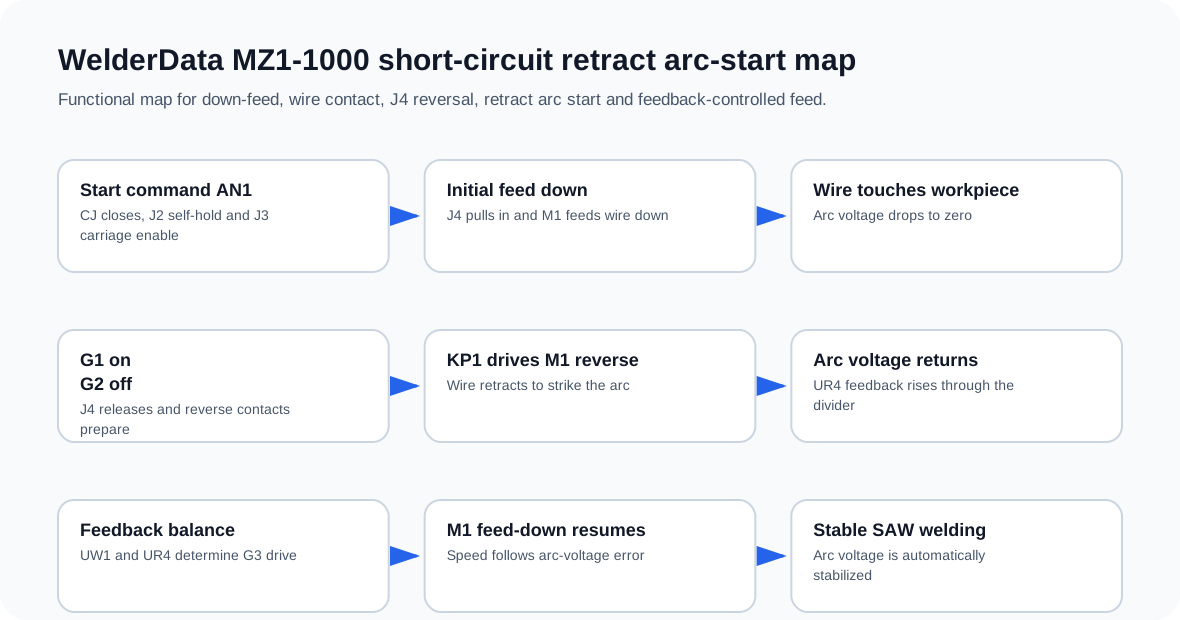
Arc-start sequence
- Pressing AN1 starts the main sequence. K3 / J / CJ enable the welding main power and J2 self-holding path.
- J2 and J3 prepare the welding indication, wire-feed control and travel-carriage control paths.
- At initial no-load condition the control logic keeps J4 in the feed-down state so M1 sends wire toward the workpiece.
- When the wire touches the workpiece, arc voltage becomes zero and UR4 becomes zero.
- The D12-D15 input polarity changes, G1 turns on, G2 turns off and J4 releases.
- J4 normally-closed contacts prepare reverse motor direction; G3 drives the KP1 trigger circuit so M1 retracts the wire.
- The wire retracts, an arc is established and arc voltage rises.
- After the arc is established, the feedback loop changes M1 speed and direction correction until arc voltage stabilizes.
Diagnostic routing
| Failure pattern | Likely section | Repair check |
|---|---|---|
| Wire feeds down but does not retract | Arc-voltage sampling, D12-D15 polarity path, G1/G2 or J4 release | Check whether wire contact drives the expected reversal state. |
| Wire retracts but arc does not establish | Welding output, work return, flux/wire condition or retract timing | Separate output-power faults from control-reversal faults. |
| Wire speed hunts after arc start | W1/R4 feedback balance, G3 bias, R13/R14 correction path | Inspect feedback divider and maximum/starting speed trims. |
| J4 contacts burn or switch under load | D11 bias switching and G3 bias timing | Check whether the bias path turns off around the relay transition interval. |