Repair Case
ZX7-250 H7B IGBT Short Circuit Lamp-Limiter Repair Case
A board-level repair case showing how a bright 220V series lamp, a shorted H7B power tube, DC bus isolation and low-voltage rail checks lead to a safer ZX7-250 fault path.
Case summary and safe starting point
This ZX7-250 case is useful because the first symptom is not vague: the machine is powered through a 220V series lamp limiter and the lamp comes on strongly. A bright lamp in this setup means the machine is pulling fault current. The correct decision is to stop full-power testing, open the cover and divide the welder into high-voltage bus, output rectifier, auxiliary supply and driver-control sections.
The machine also shows evidence of previous repair. A visibly blown power device is found, and the internal layout shows four main power devices arranged in two pairs and six output rectifier devices arranged symmetrically. This matters because a failed power tube may be the visible damage, but repeated tube failure is often caused by gate-drive, control supply or secondary-side faults that remain after the device has been replaced.
Technical H7B / DC bus isolation flow
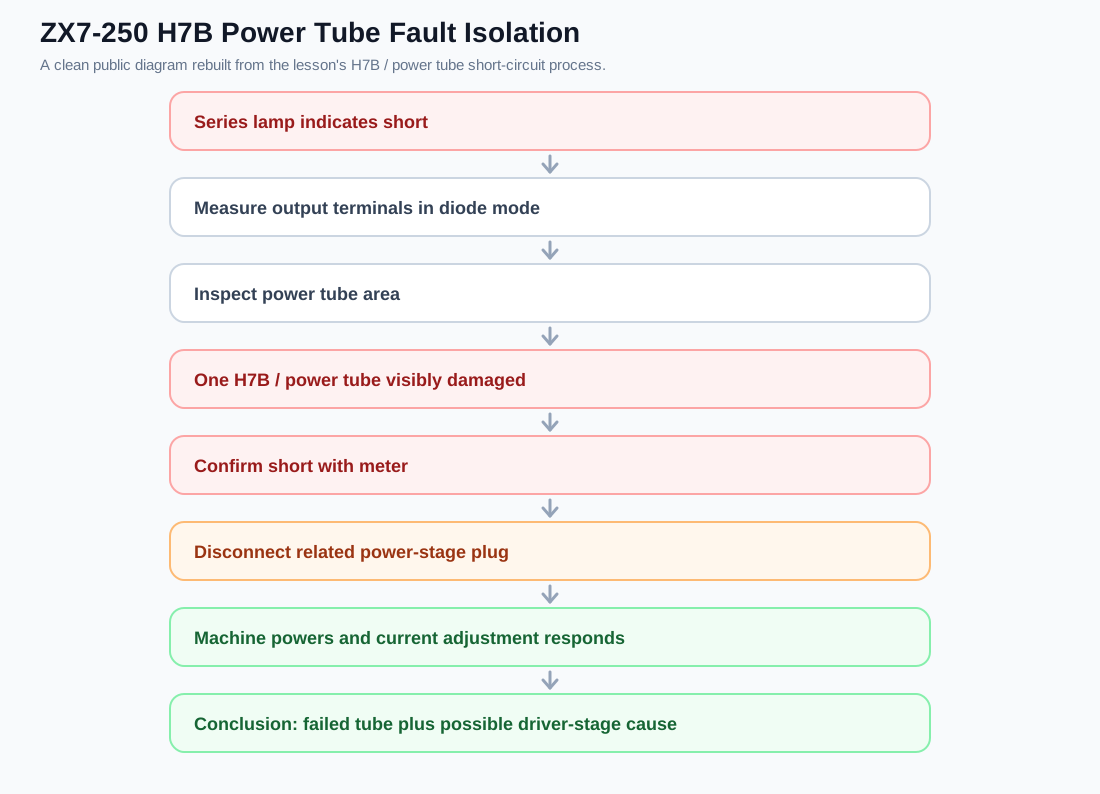
In the case, the H7B power tube is measured as shorted. That short effectively places the boosted high-voltage DC bus under fault. Once the suspected connector or power-stage path is disconnected, the power indicator and current adjustment response return. This does not prove the whole welder is repaired, but it does show that the low-voltage control side is at least partly alive and that the main fault concentration is around the power tube and its drive path.
Observed symptom table
| Observation | Field meaning | Next diagnostic action |
|---|---|---|
| Series lamp on 220V input lights strongly and stays bright | The machine is not only charging capacitors; it is drawing abnormal current | Do not bypass the lamp limiter. Open the machine and isolate the power stage. |
| Output terminals measured in diode mode show forward open and reverse around 3.6V | A multi-diode rectifier path can show a summed drop; it is not by itself proof of a direct output short | Compare with both directions and then inspect the power tube / rectifier sections. |
| One power tube is visibly damaged | The visible failure is real, but may be secondary damage | Remove or isolate the failed device before further energized testing. |
| H7B device measures shorted across main terminals | The high-voltage DC bus is effectively shorted through the power device | Check the matching device pair, gate resistor, driver transformer output and snubber parts. |
| After disconnecting the suspect plug, indicator lights and current knob response return | Control supply and display behavior are not completely dead | Continue with rail checks and driver checks before installing new power tubes. |
Why the case points beyond a single bad device
A repair path that ends at “replace the H7B” is too shallow. A power tube can fail because it is overloaded by output-side stress, because the gate signal is distorted, because one half of the bridge is driven incorrectly, because a snubber or clamp path is open, or because the auxiliary driver supply is missing on one side. In a previously repaired machine, the probability of a hidden cause is higher because the same failure may have already destroyed replacement parts.
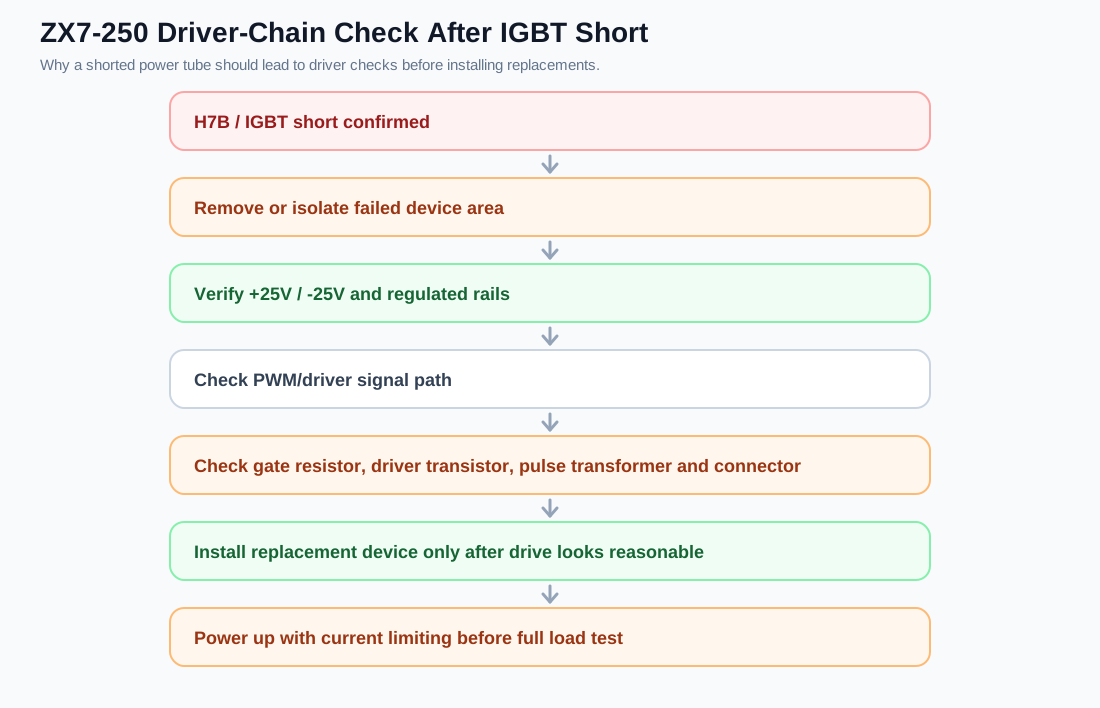
For WelderData, this case becomes a model repair record: do not fit new power devices until the driver path has been proven under current-limited conditions. Check the gate resistor network, driver transformer or pulse transformer outputs, local diodes, solder joints, connector pins and the low-voltage rails feeding the driver board. A new device installed into an unchecked driver circuit can fail instantly and make the evidence harder to read.
Control supply clues in this case
The current adjustment response after isolating the suspect power-stage connector is an important clue. It indicates that the front-panel command path, at least part of the control board and part of the low-voltage supply are still responding. The WelderData record identifies approximately +25V and -25V supply inputs and a regulator chain using 7815, 7805 and 7915 regulators. These rails should be confirmed before any PWM or driver waveform diagnosis.
| Rail or section | Expected diagnostic role | If missing or unstable |
|---|---|---|
| +25V / -25V raw low-voltage rails | Feed the regulator chain and driver/control circuits | Check auxiliary transformer, rectification, filter capacitors and board connectors. |
| 7815 output | Positive regulated supply for analog / driver support circuits | Downstream 7805 and control IC readings may become misleading. |
| 7805 output | 5V logic or control IC supply | PWM, display or protection logic may not operate correctly. |
| 7915 output | Negative regulated supply for analog sections | Current feedback and driver reference behavior can be shifted or absent. |
Repair sequence for this exact fault pattern
- Keep the lamp limiter in series during first checks. A bright lamp means stop and isolate; it is not a normal operating state.
- Record the output terminal diode-mode result before disassembly so later changes can be compared.
- Remove the failed H7B / IGBT and check the matching power device on the same switching side.
- Check fast-recovery output rectifiers for shorts before assuming the failure is only on the primary side.
- Confirm +25V, -25V, +15V, +5V and -15V rails before PWM or gate-drive troubleshooting.
- Inspect gate resistors, driver transformer outputs, solder joints and connector pins before installing new power devices.
- Use staged power-up: isolated control board first, current-limited bus next, then full bus only after drive symmetry is credible.