Cornerstone model repair hub
ZX7-250 Welder Repair Hub: Boards, Voltages and Fault Workflows
A model-centered route from visible symptom to measurement point, board function, repair case and staged validation—without assuming every ZX7-250 uses the same revision.
Reference model hub
Use this page as the ZX7-250 routing center
ZX7-250 is a market label used across multiple manufacturers and board revisions. Do not assume that every machine has the same component designators, bus voltage, power-device count or connector arrangement. The purpose of this hub is to organize the shared repair path: input protection, rectification, bus enable, auxiliary rails, PWM, gate drive, output rectification, feedback and staged validation.
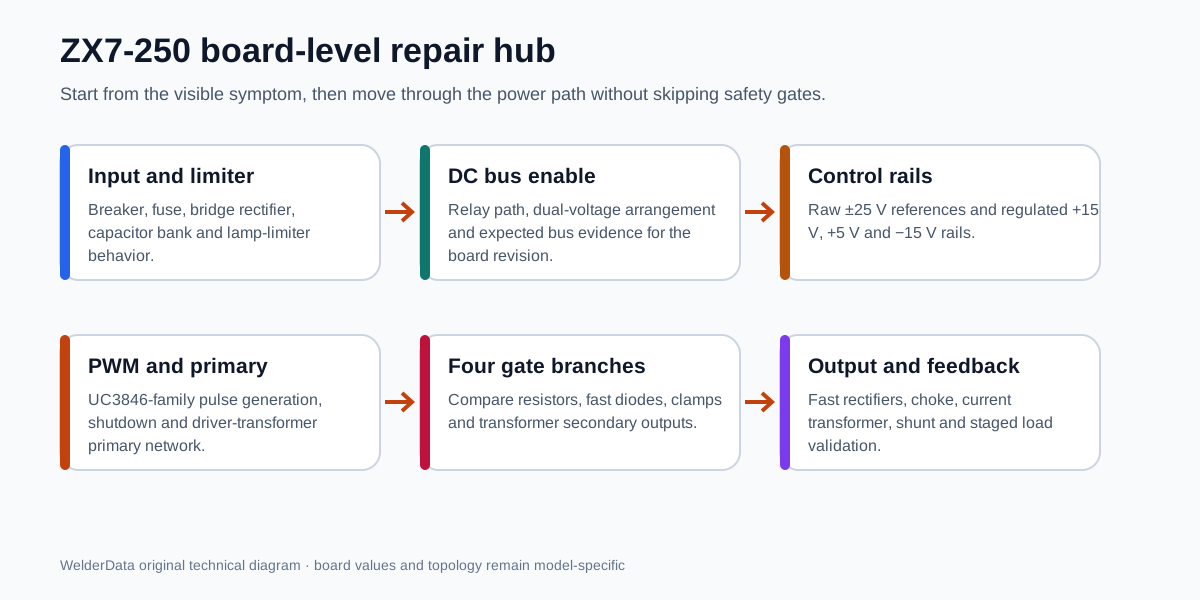
Machine architecture and board zones
| Zone | What it does | What to record |
|---|---|---|
| Input / rectifier | EMI/inrush path, bridge rectification and charging of the main capacitor bank. | Breaker/fuse behavior, lamp-limiter brightness, bridge diode readings and bus resistance. |
| Bus-enable / relay | Connects or reconfigures the high-voltage bus after control power is established. | Relay-coil voltage, contact condition, precharge path and board-specific bus target. |
| Auxiliary/control power | Supplies fan, relay, analog control, PWM and driver functions. | Raw positive/negative rails and regulated +15 V, +5 V and −15 V where this board family uses 7815/7805/7915. |
| PWM and driver primary | Creates alternating drive and feeds the driver transformer. | Controller VCC/reference/shutdown, primary waveform, N/P buffer pair and RC network. |
| Four gate branches | Drives the main switching devices through transformer secondary branches. | Branch resistance, 5.1 Ω and 20 Ω parts, fast diode, clamp/damping network and matched waveforms. |
| Output rectifier/choke | Rectifies inverter output and smooths welding current. | Fast-diode checks, suppression parts, terminal diode-mode evidence and choke/connection condition. |
| Current/thermal feedback | Controls current and trips protection. | Current-transformer path, shunt/meter input, 85 °C thermal switch where fitted and protection signal state. |
Board-specific field references already documented
One documented ZX7-250 board family uses raw control rails around +25 V and −25 V, followed by 7815, 7805 and 7915 regulation. A lesson unit showed a bright series lamp under hard-short conditions and a visibly failed H7B/power device that effectively shorted the high-voltage bus. After the suspect power-stage connection was isolated, the control section responded again. These observations are repair evidence for that board family, not universal specifications for every ZX7-250.
The same project material records a driver transformer with four secondary branches. Each branch must be compared after a power-device failure. Small 5.1 Ω and 20 Ω resistors, fast diodes, capacitors and damping/clamp parts can be damaged even when only one large device looks burnt. A primary resistance around one ohm was observed in the described unit; that value alone does not prove the transformer or secondary branches are healthy.
For output-current verification, do not confuse a display value produced during a 24 V bench test with actual welding current. The documented machine family uses external current evidence through a high-current shunt and a 75 mV meter input. Real output validation requires a safe load, suitable current measurement and the board's intended feedback path.
Symptom-to-workflow routing
| Visible symptom | Open first | Do not skip |
|---|---|---|
| Fuse/breaker trips or lamp remains bright | Input-short workflow | Bridge, capacitor bank, IGBT/H7B isolation and output rectifier. |
| Fan runs but no welding output | Fan-runs/no-output workflow | DC bus enable, +15/+5/−15 V, PWM and driver-transformer outputs. |
| Fault light on | Protection routing | Thermal switch, current feedback, driver fault and secondary short. |
| Replacement IGBT fails | ZX7-250 repeated failure | Four gate branches, snubber, fast rectifiers, feedback and staged startup. |
| No expected high-voltage bus | Bus-enable workflow | Input configuration, relay command, contact path and actual board revision. |
| Repair completed; first restart pending | Staged power-up | Thermal mounting, current limiting, no-load evidence and controlled load. |
Complete measurement sequence
- Photograph connectors, board orientation and power-device positions before removal. Record the exact board revision.
- Discharge the bus. Use resistance and diode-mode checks to locate hard shorts before energizing.
- Use a series lamp or model-appropriate current limiting only as a diagnostic aid; never treat a dim lamp as proof of a complete repair.
- Isolate a shorted power branch and confirm that control power can start without reconnecting the unsafe stage.
- Measure raw control rails and regulated rails. Stop if any rail is missing, reversed or heavily loaded.
- Check PWM-controller supply, reference, shutdown and alternating drive at the primary side.
- Compare all gate-transformer secondary branches at the same test condition. Repair small parts before installing power devices.
- Check output fast diodes, suppression components, choke and output terminals.
- Verify current-transformer, shunt and thermal-protection paths before full current.
- Perform staged restart: limited input, bus evidence, no-load output, short controlled arc and thermal/current validation.
ZX7-250 repair cluster
Applicability and safety
ZX7-250 is not one standardized circuit. Confirm input voltage, device family, board markings, connector functions and manufacturer data for the unit on the bench. Values quoted above are field references from documented board families and must not be applied blindly to another revision.
Last technical review: July 13, 2026.
Related repair map
Follow the evidence path from symptom to measurement, circuit and repair case.