Symptom Index
Welding Machine Common Symptom Index
Start from the observed fault symptom, collect one piece of evidence, then move to the correct WelderData workflow instead of guessing a board or component.
Database summary
This WelderData index is a symptom-first entry point for welding-machine repair. It does not replace model-specific procedures. It helps a technician start from a visible fault, choose the most relevant machine family, and move to a measurement workflow before replacing boards or power devices.
Use this page when the machine type is known but the first question is practical: no output, weak arc, current cannot be adjusted, fuse blows, fan runs but no arc, wire feed is unstable, TIG has no HF, plasma has air but no pilot arc, or a submerged arc tractor moves but does not weld.
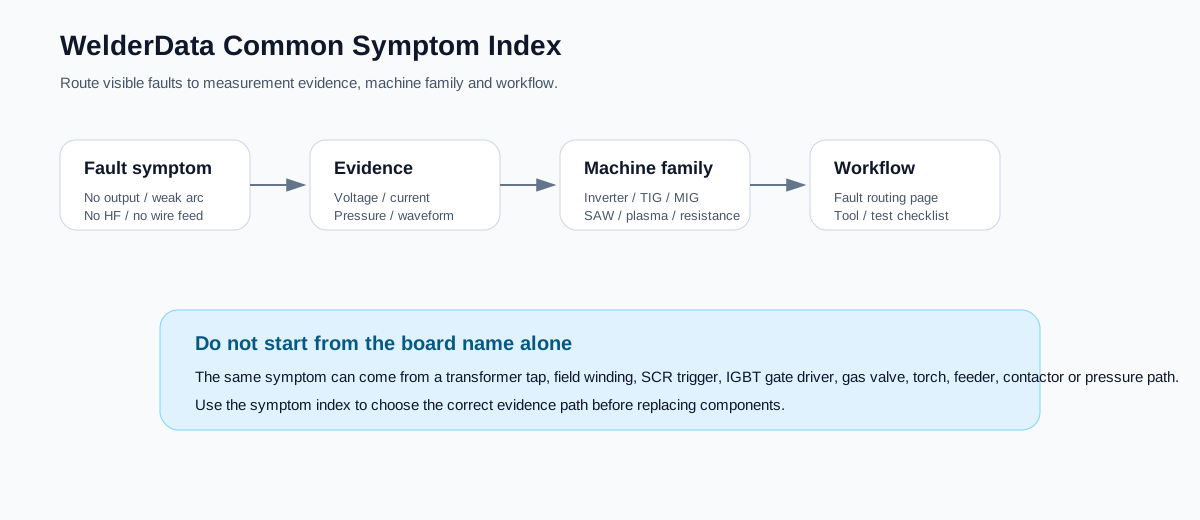
Symptom-first routing table
| Observed symptom | First evidence to collect | Likely machine-family routing | Start here |
|---|---|---|---|
| No power, no display or no fan | Input supply, switch, fuse, control transformer, auxiliary power rail and contactor coil evidence. | AC transformer, rectifier, inverter, plasma, SAW or resistance welder depending on the platform. | Field test instruments checklist |
| Fan runs or display works, but no welding output | Auxiliary rails, output enable, PWM / SCR trigger, protection state, output rectifier and output cable path. | Inverter, rectifier, TIG, MIG, plasma or SAW source. | Inverter welder powers on but no output |
| Lamp limiter stays bright or breaker trips | Input bridge, DC bus, IGBT / MOSFET, rectifier diode, snubber and output short evidence. | Inverter and rectifier power-stage checks. | Lamp limiter short diagnosis |
| IGBT / MOSFET fails again after replacement | Gate drive, negative bias, gate resistor, clamp network, snubber / resonant parts, output diode and staged restart evidence. | ZX7, Chui Shui EP, Panasonic RF2, soft-switching inverter and other IGBT power sources. | IGBT / MOSFET keeps blowing |
| Current cannot be adjusted | Panel potentiometer, current command, feedback, shunt / CT / Hall signal, calibration test point and control-board output. | ZX7, rectifier welder, rotary DC welder, MIG / CO2, SAW power source. | ZX7 current not adjustable |
| Weak arc or cannot reach rated current | Input voltage under load, output cable, rectifier, reactor, feedback scaling, current command and real current measurement. | AC transformer, rectifier, inverter, MIG / CO2, SAW and resistance welding sources. | Current display vs shunt check |
| Overheats quickly or thermal protection trips | Fan, airflow, heatsink, thermal switch, contact resistance, overload duty and shorted output component evidence. | Inverter, rectifier, plasma, resistance welding and SAW power sources. | Preventive maintenance checklist |
| Transformer hums but no arc | Secondary output, tap switch, movable core / shunt, output leads, holder and work clamp evidence. | Traditional AC transformer welders. | AC transformer arc welder fault routing |
| Brush sparks, output unstable or motor-generator overheats | Brush pressure, commutator condition, field winding, current rheostat and generator output evidence. | Rotary DC arc welders. | Rotary DC arc welder routing |
| MIG wire feed unstable or no wire feed | Torch switch, gas valve, wire-feed motor, feeder connector, remote / local command and burn-back setting. | MIG / MAG / CO2 welders, Panasonic KR / RF2 / CL4 platforms. | MIG / MAG common fault routing |
| TIG no HF, no gas or touch-start fails | Torch switch, gas solenoid, HF transformer, spark gap, arc-voltage recognition and start-mode evidence. | TIG / AC-DC TIG / pulse TIG platforms. | TIG AC/DC model-series fault reference |
| Plasma has air but no pilot arc, no HF or cannot transfer arc | Air pressure switch, HF transformer, spark gap, torch consumables, work clamp and arc-transfer evidence. | KLG / LGK / Panasonic plasma cutters. | KLG-60 plasma fault routing |
| SAW tractor moves but no welding output or wire feed is unstable | Tractor controller, source interface, arc-voltage feedback, wire-feed motor and power-source enable evidence. | MZ / MZ1 / MZ2 / MU / ZD5 / MZC submerged arc systems. | Submerged arc model-variant fault index |
| Resistance spot weld is weak, expulsion occurs or electrode sticks | Timer, transformer, electrode pressure, secondary path, cooling and electrode face condition. | Spot, seam, projection and butt resistance welders. | Resistance welding fault routing |
How to use this symptom index
- Start with the visible behavior. Do not choose a board page before the symptom is recorded.
- Collect one piece of measurement evidence. Use a meter, clamp meter, lamp limiter, scope, pressure gauge or real output check.
- Choose the matching machine family. AC transformer, rotary DC, rectifier, inverter, TIG, MIG, plasma, SAW or resistance welders use different evidence.
- Open the dedicated workflow. Use the workflow page to separate power, control, feedback, process and output evidence.
- Only then move to circuit or board references. Board-level pages are most useful after the symptom path is narrowed.
Related workflow hubs
MIG / MAG process-control evidence
Spatter, wire stubbing, burn-back and weak loaded arc are not always simple power-module failures. Route those complaints through wire feed, gas flow, voltage command, current feedback, output reactor and arc waveform evidence.
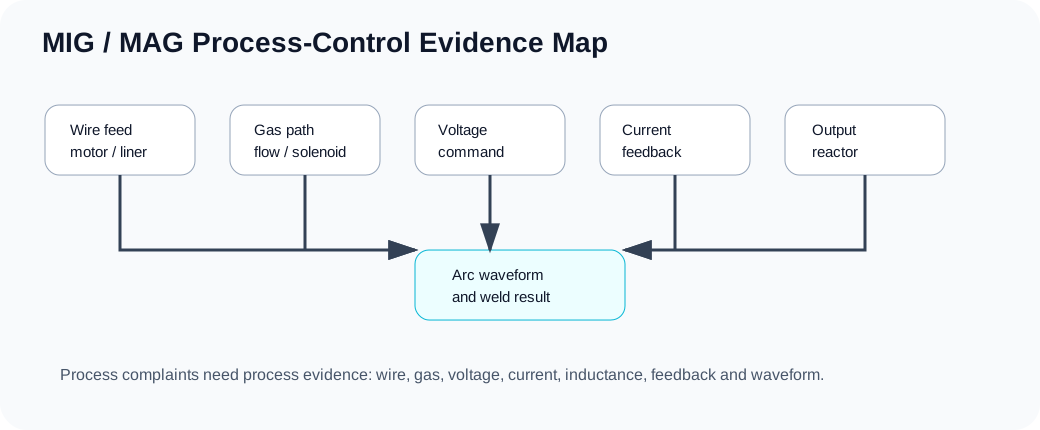
MIG / MAG process-control evidence
Spatter, wire stubbing, burn-back and weak loaded arc are not always simple power-module failures. Route those complaints through wire feed, gas flow, voltage command, current feedback, output reactor and arc waveform evidence.